SURFACE MOUNT PROCESS
  • Home
  • Articles
    • A GUIDE TO EFFECTIVE STENCIL DESIGN
    • SOLDER PASTE PRINTING PROCESS
    • SOLDER PASTE INSPECTION PROCESS
    • COMPONENT PLACEMENT PROCESS
    • REFLOW SOLDERING PROCESS
    • POST-REFLOW AOI PROCESS
    • THROUGH-HOLE ASSEMBLY - SELECTIVE SOLDERING
    • Cleaning 'No-Clean' flux residues and other contaminants
    • Environmental Protection - Conformal Coating
    • Hand soldering and rework of surface mount components to IPC class 3
  • FAQ
    • Solder paste handling
    • Type 3 or Type 4 Solder Paste
    • Cleaning a misprinted PCB
    • Solder Paste Quality Control
    • What factors affect solder paste transfer efficiency
    • What stencil thickness should be used?
    • What is the difference between aspect ratio and area ratio of stencil apertures?
    • What squeegee speed should be used?
    • What squeegee pressure should be used?
    • What the differences between 'on-contact' printing and 'gap' printing?
    • What separation speed to use in solder paste printing?
    • What are the benefits / challenges of using halogen-free solder paste?
    • What is the best stencil aperture shape for solder paste transfer efficiency?
    • PCB delamination during reflow
    • What are the different types of reflow profile?
    • ROSE (Resistivity of Solvent Extract) testing
    • How do you validate a PCBA cleaning process?
    • Why clean a pcba that has been soldered using no-clean flux
    • How do engineered cleaning fluids such as Zestron and Kyzen work
    • How do engineered cleaning fluids affect surface tension and wetting angle?
    • How does the pH level affect engineered cleaning fluids?
    • How do mixed-bed and carbon filters work in PCB cleaning systems?
    • What are the risks of using ultrasonics to clean PCBA's?
    • What are the differences between 'Water-soluble' and 'No-clean' flux?
    • What is the difference between ionic and non-ionic contamination?
    • What causes electrochemical migration (ECM)?
    • What are methods of masking before conformal coating?
    • How to apply conformal coating by brushing?
    • How to apply conformal coating using dipping?
    • How to apply conformal coating using spray/aerosol?
    • How do selective robots apply conformal coating?
    • What is the best method to dry/cure conformal coating?
    • What concerns are there when demasking?
    • What should be checked when inspecting after conformal coating?
    • How to check the adhesion of conformal coating?
    • Tape and Reel Packaging Standards
    • What is 'Package on Package' (POP)?
    • Stock control and component attrition
    • BOM Comparison Software
    • Comparison of SAC305 and SAC387 Lead-Free Solder Alloys
    • What is a 'Eutectic' solder alloy?
    • What does 'SMT' stand for?
    • What does the term voiding mean?
    • How is void percentage calculated?
    • How to reduce voids in QFN device ground connection?
    • Low temperature lead free solder paste
    • CAD EXTRACTION
    • How are PCB's manufactured?
    • What are the IPC standards that govern electronics manufacturing processes?
    • What are the differences between SMEMA and HERMES?
  • Contact
  • Store
Picture

THROUGH HOLE TROUBLSHOOTING GUIDE
Through Hole Soldering Defects

Picture

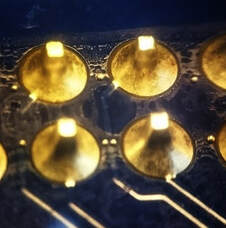
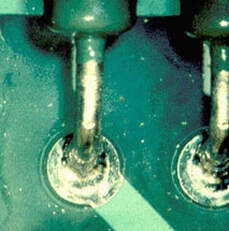
Insufficient Hole Fill

Possible Causes: Inadequate flux, topside PCB temperature too low, wave height to low, lead-to-hole ratio too small, PCB contains solder joints connected to internal ground planes.
Preventive Actions: Verify flux deposition, verify preheat temperature, check wave height, check lead-to-hole aspect ratio, verify internal ground planes
Picture

Insufficient Wetting

Possible Causes: Inadequate flux, dwell time too short, topside PCB temperature too low, poor solderability, contamination
Preventive Actions: Verify flux deposition, reduce drag speed/Increase solder time, verify preheat temperature, check component for contamination, check board contamination
Picture

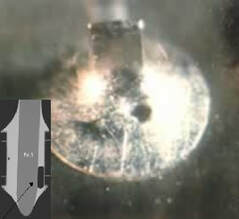
Blow Holes and Voids

Possible Causes: Topside PCB temperature too low, flux carrier outgassing, moisture in PCB, poor through-hole plating
Preventive Actions: Verify topside PCB temperature, verify flux deposition and required preheat temperature, check for moisture in laminate - prebake if necessary, check though-hole plating
Picture

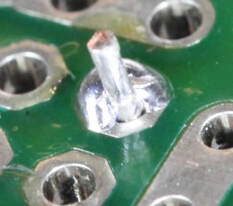
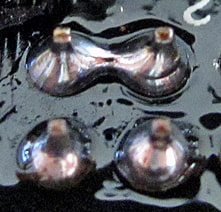
Solder Bridging

Possible Causes: Protruding lead length too long, inadequate flux,  solder drag speed too fast, nozzle peel-off movement
Preventive Actions: Reduce lead protrusion length, verify flux deposition, decrease drag speed, re-program peel-off movement
Picture

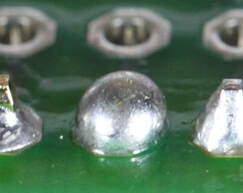
Solder Balls (Attached firmly to solder mask)

Possible Causes: Excessive flux, topside PCB temperature too
low, solder temperature too high, solder mask porosity
Preventive Actions: Reduce amount of flux, verify topside PCB
temperature, consider using lower temperature lead-free alloy, consider alternative solder mask material
Picture

Sunken Solder Joints

Possible Causes: Lead-to-hole ratio too large, moisture in PCB, flux carrier outgassing, topside PCB temperature too low, poor through-hole plating, poor solderability
Preventive Actions: Reduce lead-to-hole ratio, check for moisture in laminate - prebake if necessary, verify topside PCB temperature, check though-hole plating, check component for contamination
Picture

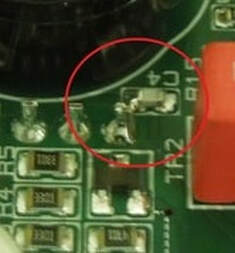
Adjacent Component Solder Short

Possible Causes: Inadequate TH to SMT clearance, lead length too long, solder nozzle movement, solder nozzle peel-off movement
Preventive Actions: Implement keep-out DFMA guidelines, reduce lead protrusion length, re-program nozzle movement, re-program peel-off movement
Picture

Excessive Solder

Possible Causes: Protruding lead length too long, inadequate flux,  solder drag speed too fast, nozzle peel-off movement
Preventive Actions: Reduce lead protrusion length, verify flux deposition, decrease drag speed, re-program peel-off movement
Picture

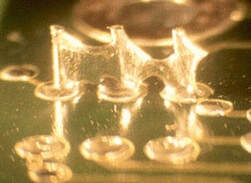
Solder Flags

Possible Causes: Protruding lead length too long, inadequate flux,  solder drag speed too fast, nozzle peel-off movement
Preventive Actions: Reduce lead protrusion length, verify flux deposition, decrease drag speed, re-program peel-off movement
© COPYRIGHT 2015. ALL RIGHTS RESERVED.