SURFACE MOUNT PROCESS
  • Home
  • Articles
    • A GUIDE TO EFFECTIVE STENCIL DESIGN
    • SOLDER PASTE PRINTING PROCESS
    • SOLDER PASTE INSPECTION PROCESS
    • COMPONENT PLACEMENT PROCESS
    • REFLOW SOLDERING PROCESS
    • POST-REFLOW AOI PROCESS
    • THROUGH-HOLE ASSEMBLY - SELECTIVE SOLDERING
    • Cleaning 'No-Clean' flux residues and other contaminants
    • Environmental Protection - Conformal Coating
    • Hand soldering and rework of surface mount components to IPC class 3
  • FAQ
    • Solder paste handling
    • Type 3 or Type 4 Solder Paste
    • Cleaning a misprinted PCB
    • Solder Paste Quality Control
    • What factors affect solder paste transfer efficiency
    • What stencil thickness should be used?
    • What is the difference between aspect ratio and area ratio of stencil apertures?
    • What squeegee speed should be used?
    • What squeegee pressure should be used?
    • What the differences between 'on-contact' printing and 'gap' printing?
    • What separation speed to use in solder paste printing?
    • What are the benefits / challenges of using halogen-free solder paste?
    • What is the best stencil aperture shape for solder paste transfer efficiency?
    • PCB delamination during reflow
    • What are the different types of reflow profile?
    • ROSE (Resistivity of Solvent Extract) testing
    • How do you validate a PCBA cleaning process?
    • Why clean a pcba that has been soldered using no-clean flux
    • How do engineered cleaning fluids such as Zestron and Kyzen work
    • How do engineered cleaning fluids affect surface tension and wetting angle?
    • How does the pH level affect engineered cleaning fluids?
    • How do mixed-bed and carbon filters work in PCB cleaning systems?
    • What are the risks of using ultrasonics to clean PCBA's?
    • What are the differences between 'Water-soluble' and 'No-clean' flux?
    • What is the difference between ionic and non-ionic contamination?
    • What causes electrochemical migration (ECM)?
    • What are methods of masking before conformal coating?
    • How to apply conformal coating by brushing?
    • How to apply conformal coating using dipping?
    • How to apply conformal coating using spray/aerosol?
    • How do selective robots apply conformal coating?
    • What is the best method to dry/cure conformal coating?
    • What concerns are there when demasking?
    • What should be checked when inspecting after conformal coating?
    • How to check the adhesion of conformal coating?
    • Tape and Reel Packaging Standards
    • What is 'Package on Package' (POP)?
    • Stock control and component attrition
    • BOM Comparison Software
    • Comparison of SAC305 and SAC387 Lead-Free Solder Alloys
    • What is a 'Eutectic' solder alloy?
    • What does 'SMT' stand for?
    • What does the term voiding mean?
    • How is void percentage calculated?
    • How to reduce voids in QFN device ground connection?
    • Low temperature lead free solder paste
    • CAD EXTRACTION
    • How are PCB's manufactured?
    • What are the IPC standards that govern electronics manufacturing processes?
    • What are the differences between SMEMA and HERMES?
  • Contact

What are the IPC standards that govern electronics manufacturing processes?

Picture

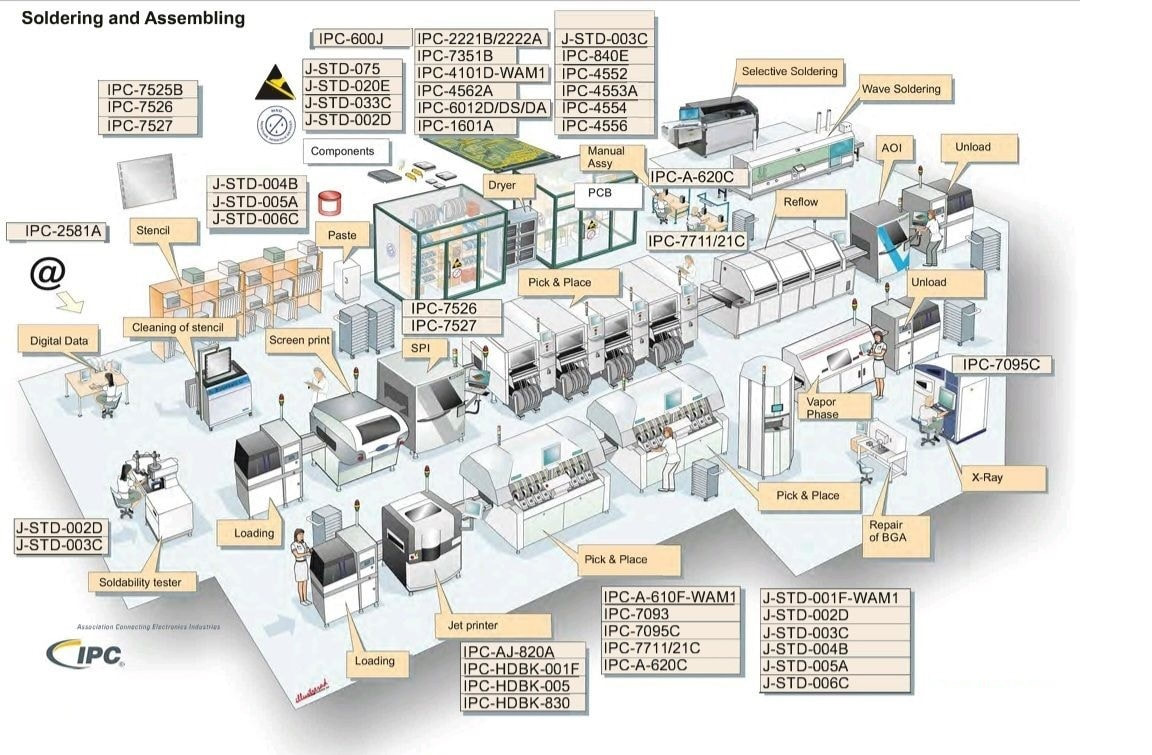
IPC Standards for Soldering and Assembling

The Association Connecting Electronics Industries (IPC) is an organization that sets industry standards for electronics manufacturing and assembly processes. There are various IPC standards that govern different aspects of electronics manufacturing. Some of the important IPC standards include:

  1. IPC-A-600: Acceptability of Printed Boards - This standard defines the acceptability criteria for PCBs (printed circuit boards), covering materials, fabrication processes, and inspection criteria.
  2. IPC-A-610: Acceptability of Electronic Assemblies - This standard establishes the acceptability criteria for electronic assemblies, including soldering criteria, component placement, and various assembly processes.
  3. IPC-J-STD-001: Requirements for Soldered Electrical and Electronic Assemblies - This standard outlines the requirements for soldering processes, materials, and inspection criteria for electronic assemblies. It is often used in conjunction with IPC-A-610.
  4. IPC-7711/7721: Rework, Modification, and Repair of Electronic Assemblies - This set of standards provides guidelines for reworking, modifying, and repairing electronic assemblies. IPC-7711 addresses rework of electronic assemblies, while IPC-7721 covers modification and repair.
  5. IPC-7351: Generic Requirements for Surface Mount Design and Land Pattern Standard - This standard provides guidelines for designing surface mount component land patterns on PCBs to ensure proper soldering and assembly.
  6. IPC-2221: Generic Standard on Printed Board Design - This standard defines the requirements for the design of printed boards, including layout, materials, and tolerances.
  7. IPC-6012: Qualification and Performance Specification for Rigid Printed Boards - This standard specifies the performance requirements for rigid PCBs, including material quality, electrical and mechanical characteristics, and reliability.
  8. IPC-6013: Qualification and Performance Specification for Flexible Printed Boards - Similar to IPC-6012, this standard specifies the requirements for flexible PCBs.
  9. IPC-620: Requirements and Acceptance for Cable and Wire Harness Assemblies - This standard covers the acceptability criteria for cable and wire harness assemblies, including materials, fabrication processes, and inspection criteria.
  10. IPC-9252: Requirements for Electrical Testing of Unpopulated Printed Boards - This standard outlines the requirements for electrical testing of unpopulated PCBs, including procedures and criteria.
  11. IPC-4552: Specification for Electroless Nickel/Immersion Gold (ENIG) Plating for Printed Boards - This standard defines the requirements for ENIG surface finish, which is commonly used in PCBs.
  12. IPC-T-50: Terms and Definitions for Interconnecting and Packaging Electronic Circuits - This document provides a comprehensive glossary of terms related to electronics manufacturing and assembly.

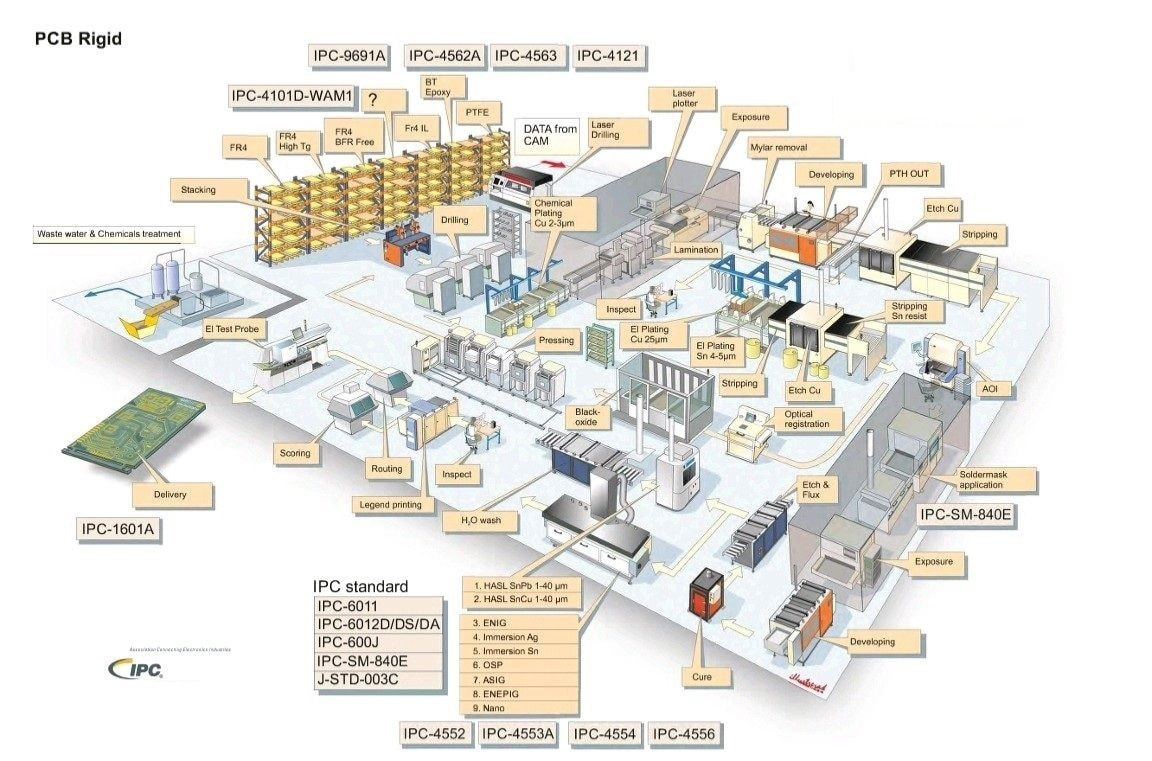
IPC Standards for PCB Manufacturing
Picture

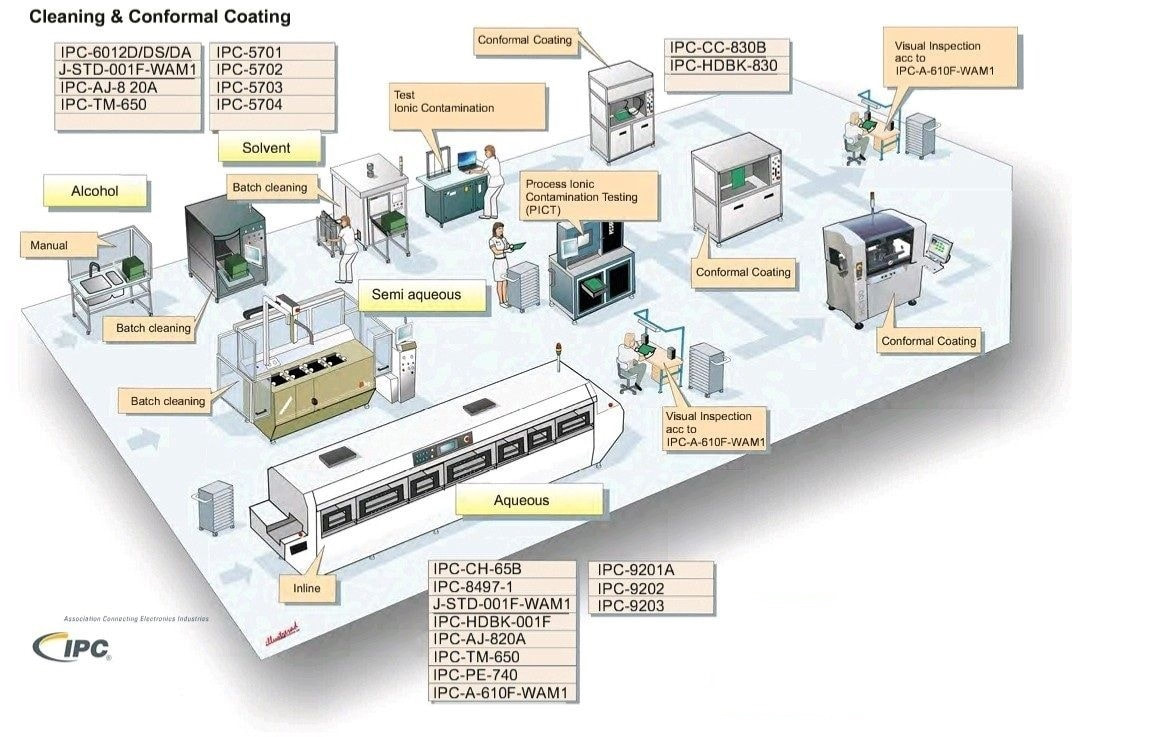
IPC Standards for Cleaning and Conformal Coating
Picture
These are just a few of the many IPC standards that exist to govern various aspects of electronics manufacturing processes. These standards help ensure consistency, quality, and reliability in the electronics industry, and they are widely used and recognized by manufacturers, assemblers, and quality control professionals.
© COPYRIGHT 2015. ALL RIGHTS RESERVED.
